How to Choose the Right Retractable Pool Cover for Your Swimming Pool
A swimming pool is a wonderful addition to any home, but keeping it clean, comfortable and ready to use throughout the year takes effort.
Leaves, dust, insects, rain and changing temperatures can all affect your swimming experience. An uncovered pool may also require more frequent cleaning and maintenance, especially when it is surrounded by trees or exposed to the elements.
So, what is the best way to protect your pool without permanently sacrificing the pleasure of swimming outdoors?
A retractable pool cover is an option worth considering. Unlike traditional pool covers that need to be manually removed and stored, a retractable pool enclosure uses a sliding structure that allows you to switch between an enclosed and open-air swimming environment.
However, not all pool covers are designed for the same purpose. Some prioritize basic pool protection, while others allow you to swim underneath the enclosure or even create a complete indoor-style pool space.
In this guide, we will walk you through the most important factors to consider when choosing a retractable pool cover, helping you find a solution that fits your swimming pool, lifestyle and budget.
1. Start With Your Main Purpose: What Do You Expect From a Pool Cover?
Before comparing products, think about how you actually use your swimming pool.
Different homeowners have different priorities, and identifying yours is the first step toward choosing the right design.
If your main goal is keeping the pool clean:
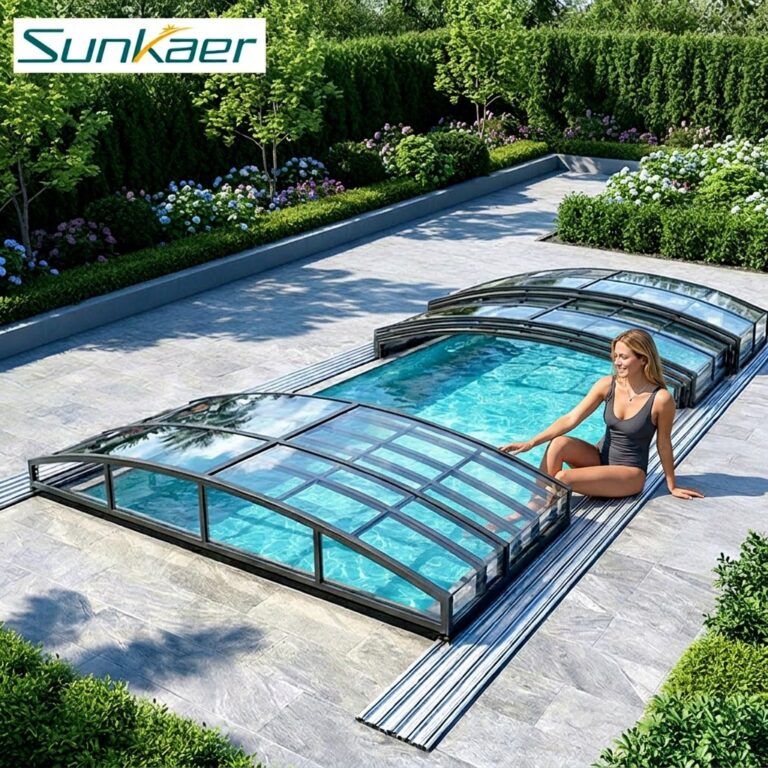
You may prefer a low-profile retractable pool cover that helps keep leaves, dust and insects out of the water while maintaining an unobstructed view of your garden.
If you want to swim when the enclosure is closed:
Consider a medium-height enclosure that provides sufficient clearance above the water for swimming while keeping the overall structure relatively low.
If you want more than just a pool cover:
A high-profile retractable pool enclosure can create a more spacious environment where you can swim, walk around the pool and arrange lounge chairs or other furniture.
Think of it as creating an additional outdoor living space rather than simply covering the water.
The right choice depends on how much space you want to use and what kind of swimming experience you expect.
2. Choose the Right Height: Low, Medium or High?
Height is one of the most important factors when selecting a retractable pool enclosure. It determines not only the appearance of the structure but also how you can use the space underneath it.
Low-Profile Retractable Pool Cover
A low-profile pool cover is designed primarily to protect the water surface while keeping the enclosure visually discreet.
Main advantages:
- Helps keep leaves, dust and insects out of the pool.
- Reduces direct exposure to outdoor elements.
- Maintains a relatively unobstructed garden view.
- Requires less vertical space.
- Can be fully retracted to reopen the pool.
However, low-profile designs generally do not provide enough clearance for walking around the pool. Swimming underneath also depends on the actual model and available height.
Best for: Homeowners who prioritize pool protection, a minimalist appearance and maintaining the original look of their garden.
Medium-Height Retractable Pool Enclosure
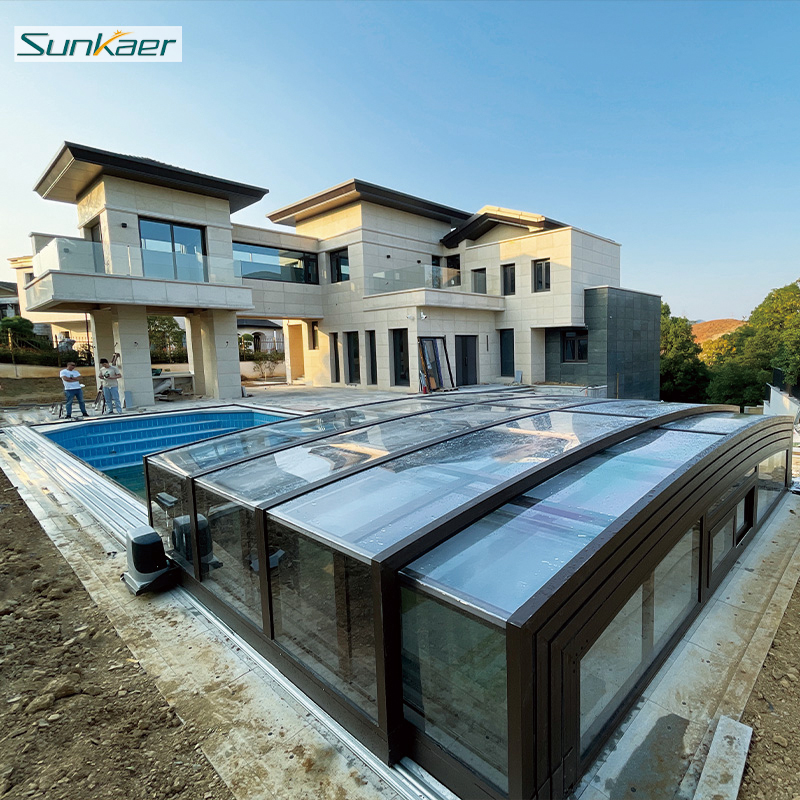
A medium-height enclosure offers a balance between a relatively low visual profile and practical swimming space.
Unlike many low covers, a properly specified medium-height design allows you to swim while the enclosure remains closed.
Main advantages:
- Provides clearance for swimming underneath.
- Helps protect the pool from leaves and outdoor debris.
- Allows natural light to enter through transparent panels.
- Offers a more sheltered swimming environment.
- Can be opened when you prefer outdoor swimming.
It is important to confirm the actual internal height and clearance for your pool before ordering.
Best for: Pool owners who want to swim in a more sheltered environment without installing a full-height structure.
High-Profile Retractable Pool House
If you want to transform your swimming pool into a more complete leisure space, a high-profile enclosure may be the better choice.
With sufficient internal clearance, you can move around the pool, arrange lounge chairs and enjoy the surrounding space even when the enclosure is closed.
Main advantages:
- Allows swimming and walking underneath.
- Creates a more spacious enclosed environment.
- Provides room for poolside furniture and relaxation areas.
- Offers greater flexibility for family gatherings and leisure activities.
- Can make the pool area more usable in different weather conditions.
Because a high enclosure has a larger structural profile, its dimensions, anchoring and resistance to local wind and snow loads require particular attention.
Best for: Homeowners who want a more complete indoor-outdoor pool experience rather than a simple protective cover.
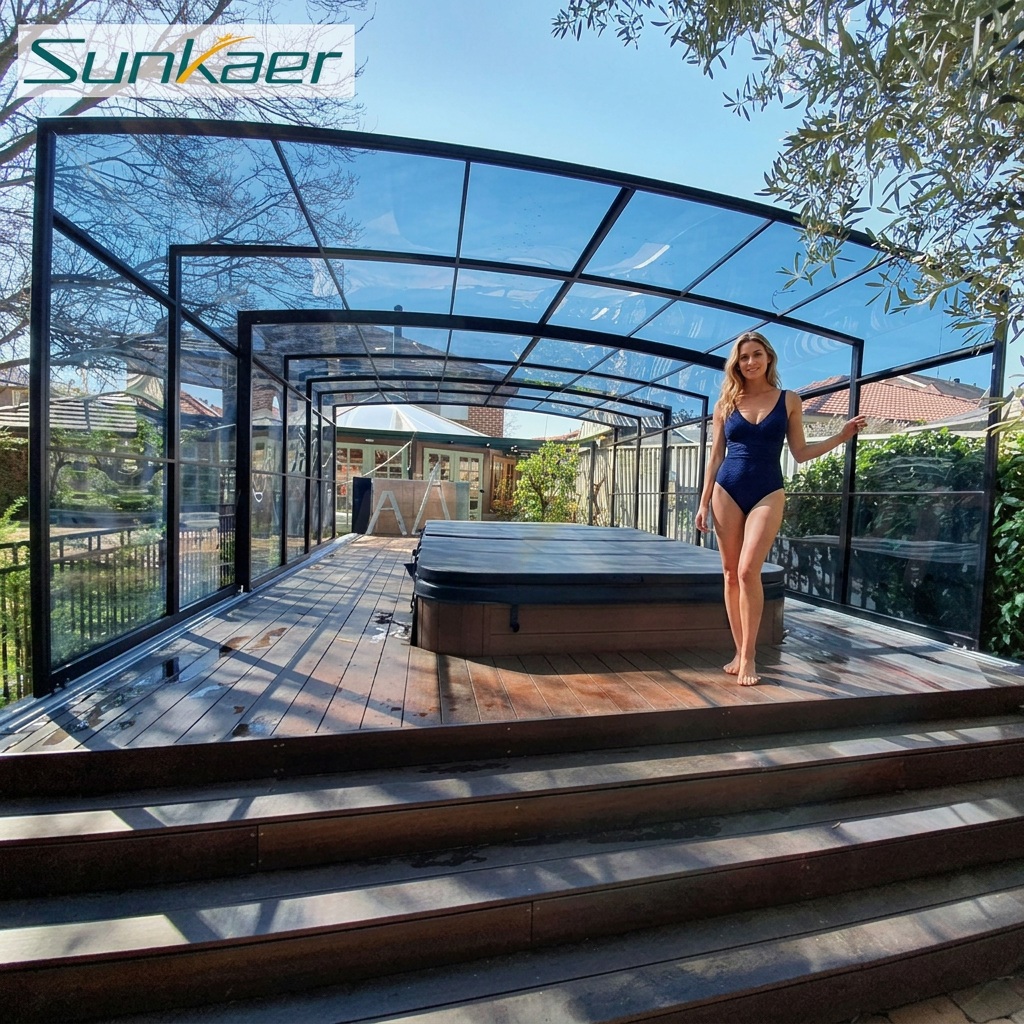
Quick Comparison: Which Height Is Right for You?
| Feature | Low | Medium | High |
|---|---|---|---|
| Protects pool from debris | Yes | Yes | Yes |
| Swim when closed | Model-dependent | Yes, with suitable clearance | Yes, with suitable clearance |
| Walk around pool when closed | Generally no | Limited/model-dependent | Yes, with suitable clearance |
| Accommodates lounge furniture | Generally no | Limited | Yes |
| Visual profile | Lowest | Medium | Highest |
| Main purpose | Pool protection | Protected swimming | Complete pool space |
Sunkaer Tip: Do not choose a pool cover based on external height alone. Ask for the actual internal clearance and consider how you intend to use the space.
3. Choose the Right Material: Polycarbonate or Glass?
The material used for your pool enclosure affects its weight, durability, maintenance and overall appearance.
Two commonly discussed options are polycarbonate panels and glass.
Why Consider Polycarbonate Panels?
Polycarbonate is an engineering plastic known for its relatively low weight and high impact resistance.
For retractable pool enclosures, these characteristics offer several practical advantages.
Lightweight construction
Polycarbonate panels are generally much lighter than comparable glass panels. This is particularly relevant for a retractable system, where the weight of the moving sections affects the structural design and operation.
Impact resistance
Quality polycarbonate offers strong resistance to impact. Unlike glass, which can crack or shatter under certain conditions, polycarbonate is less prone to breaking into dangerous sharp fragments.
Natural light
Clear polycarbonate panels allow natural light into the enclosed pool area, helping maintain a bright and open atmosphere.
UV protection
Quality UV-protected polycarbonate panels can help reduce the effects of prolonged sunlight exposure on the material.
When comparing products, check the panel thickness, UV protection specification, transparency and written warranty rather than relying on the material name alone.
What About Glass?
Glass offers excellent optical clarity and a familiar architectural appearance. However, it is considerably heavier than many comparable polycarbonate panels.
For a retractable structure, this additional weight can affect the design of the frame, tracks and moving sections.
Glass may be suitable for certain fixed architectural applications, while polycarbonate is often worth considering when a lighter retractable enclosure is the priority.
For homeowners looking for a movable pool cover, we recommend comparing the complete structural system rather than looking at panel transparency alone.
4. Manual or Motorized: Which Operating System Should You Choose?
Another important decision is how you want to open and close your pool enclosure.
Manual Retractable Pool Cover
A manual system uses a sliding mechanism that allows the enclosure to be moved by hand.
For many residential swimming pools, this is a practical option because pool covers are generally not opened and closed continuously throughout the day.
Advantages include:
- Straightforward operating structure.
- No electrical connection required for operation.
- Fewer electrical components to maintain.
- A practical choice for many residential applications.
- Lower initial system complexity.
A properly designed track system and appropriately sized enclosure are important for smooth manual operation.
Motorized Retractable Pool Cover
A motorized system uses an electric drive to move the enclosure, often with remote control.
It may be more convenient when the structure is large, heavy, frequently operated or used in a commercial environment.
Advantages include:
- Convenient opening and closing.
- Less physical effort for users.
- Suitable for certain large or frequently operated installations.
- Can offer remote-control operation.
However, a motorized system also introduces additional electrical and mechanical components. Buyers should consider maintenance, local service availability and replacement-part arrangements before choosing this option.
Our recommendation: For many residential applications, a well-designed manual system can be a sensible and reliable choice. For larger commercial projects or applications requiring frequent operation, motorization may be worth considering.
The best option depends on the enclosure’s dimensions, operating frequency and local after-sales support.
5. Measure Your Swimming Pool and Available Installation Space
Even the best-quality pool enclosure will not work properly if it does not fit the actual site.
Before requesting a quotation, take time to measure your swimming pool and surrounding area.
Pool Dimensions
Start with the following measurements:
- Pool length.
- Pool width.
- Pool shape.
- Distance from the pool edge to nearby walls or buildings.
- Available installation height and clearance.
If your swimming pool has an irregular shape, provide a drawing or several photographs showing its outline.
Surrounding Installation Space
This is particularly important for retractable enclosures.
Unlike a fixed roof, a sliding pool cover needs sufficient space for the sections to move when opening.
Check:
- Where the enclosure will move when fully retracted.
- Whether there are nearby walls, fences or trees.
- Whether the tracks can be installed on a suitable supporting surface.
- Whether there is enough room for drainage and maintenance access.
- Whether the delivery and installation team can access the site.
A few clear photographs from different angles can help the manufacturer understand the installation conditions.
Custom Dimensions Matter
Standard-sized pool covers may not suit every swimming pool.
A customized retractable enclosure can be designed around the pool dimensions and surrounding layout, allowing you to consider the most appropriate width, length and height.
At Sunkaer, we focus on customized solutions rather than asking every customer to adapt their pool to a standard enclosure.
6. Consider Your Local Climate Before Choosing a Design
Your geographical location plays an important role in determining the appropriate pool enclosure specification.
A design suitable for a mild coastal climate may require different structural considerations from one installed in an area with heavy snowfall or strong seasonal winds.
For areas with strong sunlight:
Consider UV-protected polycarbonate panels, suitable ventilation and optional shading solutions.
For areas with heavy rain:
Pay attention to the roof design, drainage and installation details to help manage rainwater.
For areas with strong winds:
The structural frame, connections, anchoring system and permitted operating conditions should be evaluated against the site’s design wind loads.
For areas with snow:
Snow accumulation and the applicable structural snow load must be considered when specifying the enclosure. The cover should not be assumed suitable for heavy snow unless the system has been engineered and approved for those conditions.
Before purchasing, discuss local weather requirements with the manufacturer and qualified local professionals.
7. Check the Quality of the Aluminum Structure and Sliding System
A retractable pool enclosure is not just a collection of panels. Its performance depends on how the entire system is designed and manufactured.
Pay attention to these details:
Aluminum profiles: Check the alloy specification, profile dimensions, surface treatment and structural design.
Sliding tracks: Make sure the track arrangement is suitable for the enclosure’s dimensions and operating requirements.
Connections and fasteners: Ask about the materials and protective treatments used for joints and hardware, especially in humid pool environments.
Sealing and drainage: Check how the system manages rainwater and how the enclosure closes around the pool area.
Warranty: Understand what is covered, how long the coverage lasts and how after-sales support is provided.
These details are often more important for long-term satisfaction than choosing a product based on appearance alone.
8. Why Choose Sunkaer Retractable Polycarbonate Pool Covers?
After understanding the key selection factors, you may find that a customized retractable enclosure is a better fit for your swimming pool than a conventional fixed cover.
This is where Sunkaer comes in.
With more than 20 years of experience in the outdoor sunshade and enclosure industry, Sunkaer specializes in customized aluminum and polycarbonate solutions for residential and commercial projects.
Customized for Your Swimming Pool
Every pool is different. We help customers explore suitable dimensions and configurations based on their actual site conditions.
Sunkaer offers different height options:
- Low-profile pool covers for a discreet appearance and basic pool protection.
- Medium-height enclosures for swimming underneath while closed.
- High-profile pool houses for a more spacious enclosed swimming and relaxation area.
The final design is determined by the pool dimensions, available installation space and intended use.
Polycarbonate Panels With UV Protection
Sunkaer uses UV-protected solid polycarbonate sheets designed for outdoor applications.
Our polycarbonate sheets come with a 10-year warranty against aging and yellowing, subject to the applicable warranty terms.
Durable Aluminum Structure
The aluminum framework provides support for the polycarbonate panels and sliding system.
Sunkaer provides a 30-year warranty against rusting and deformation for its aluminum structure, subject to the written warranty conditions.
Manual and Motorized Options
Depending on the selected design and project requirements, customers can explore manual or motorized operation.
Additional options may include different frame colors, panel types, lighting and other customized features.
From Site Assessment to Custom Design
You do not need to know every technical detail before contacting us.
Simply provide:
- Your swimming pool length and width.
- Several photographs of the pool and surrounding area.
- Your country and city.
- Your preferred enclosure height, if known.
- Whether you prefer manual or motorized operation.
Our team can review the information, discuss suitable configurations and prepare an initial customized quotation.
9. Ready to Choose Your Retractable Pool Cover?
Choosing the right retractable pool cover is about finding the balance between protection, convenience, appearance and budget.
A low-profile cover may be sufficient if your main priority is keeping the pool clean. A medium-height enclosure can offer a more sheltered swimming experience, while a high-profile pool house can create a more complete outdoor leisure space.
The best solution is the one that fits your swimming pool and the way you want to enjoy it.
Why settle for a standard pool cover when your swimming pool can have a solution designed around it?
Explore Sunkaer’s Customized Polycarbonate Pool Covers and discover the possibilities of a retractable swimming pool enclosure.
Have a project in mind?
Contact Sunkaer with your pool dimensions and site photos. Let us help you find the right retractable pool cover for your home.
Frequently Asked Questions
1. What is the best type of retractable pool cover?
The best type depends on your priorities. Low-profile covers focus on pool protection, medium-height covers provide clearance for swimming underneath, and high-profile enclosures create more usable space around the pool.
2. Can I swim under a retractable pool cover?
Yes, if the enclosure provides sufficient internal clearance. Medium and high models are generally more suitable for swimming underneath when closed. Always confirm the actual internal height before ordering.
3. Is polycarbonate better than glass for a retractable pool enclosure?
Polycarbonate is lighter and offers strong impact resistance, making it an attractive option for many retractable structures. Glass offers different optical and architectural characteristics but adds considerably more weight. The best choice depends on the project.
4. Should I choose a manual or automatic pool cover?
Manual operation is often a practical choice for residential pools with moderate operating frequency. Motorized operation may be more convenient for large enclosures or commercial applications where the system is used more frequently.
5. Can I customize the dimensions of my retractable pool cover?
Yes. Sunkaer offers customized pool enclosure solutions based on your pool dimensions, installation space, preferred height and design requirements.
6. Does a retractable pool cover help keep the water warm?
An enclosure can help reduce heat loss and create a more sheltered environment, depending on its design and local conditions. The actual temperature benefit varies with sunlight, ventilation, water temperature and other factors. It should not be treated as a replacement for a properly sized pool heating system.
7. How much does a customized retractable pool cover cost?
The price depends on the enclosure dimensions, height, materials, operating system, customization, shipping and installation requirements. Providing pool measurements and site photos is the best way to obtain an initial quotation.
8. Is a retractable pool enclosure a safety barrier for children?
A retractable enclosure may provide a physical barrier when appropriately designed and secured, but it should not automatically be considered a compliant swimming pool safety barrier. Check local pool safety regulations and install any required independent fencing, gates, alarms or other protective measures.